
Reviewed · WALKING TOURS
The Real Story of Belfast walking tour with a local guide
Belfast’s story is written into its narrow lanes, old pubs, churches, warehouses, and grand civic buildings. This walking tour connects those places in a clear, human way, moving from the city’s early growth through industry, politics, religion, and the Troubles. Local guide Martin also adds personal knowledge from growing up in Belfast, which gives the walk a useful sense of place.
I like the small maximum group of 12, since you can hear the guide and ask questions without shouting across a crowd. I also like the broad focus: this is not only a Troubles tour. You get Belfast’s older story, including linen, trade, religion, revolution, entertainment, and daily life.
The main drawback is the length. At nearly three hours, this is a serious walking tour rather than a quick orientation. You need comfortable shoes, suitable clothing for rain, and enough energy to stay engaged through a lot of information.
Key things to know before you book
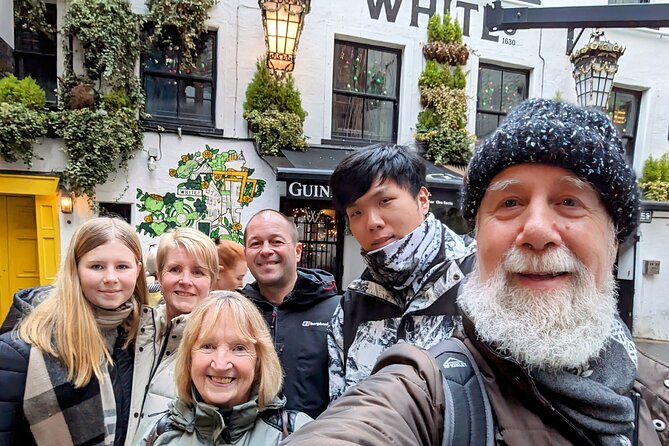
- Martin’s personal connection: Local guide Martin uses his own experience of Belfast to help explain its past and present.
- A wider Belfast story: The walk covers the city’s growth over centuries, while also giving the Troubles their necessary context.
- Small-group format: The tour is capped at 12 people, allowing for questions and a more direct connection with the guide.
- Old lanes and living landmarks: You’ll walk through the Belfast Entries, stop at Kelly’s Cellars, and see places still tied to city life.
- Almost three hours on foot: The pace is described as leisurely, but the distance and length call for moderate fitness.
- Useful first-day tour: Starting and ending at City Hall makes this a practical way to get your bearings before exploring alone.
Why this Belfast walk works as an introduction
The best city walks do more than point at buildings. They show you how separate parts of a place fit together. This one links civic Belfast at City Hall with the old lanes, Catholic and Protestant landmarks, linen warehouses, entertainment venues, and hotels tied to modern political life.
That range matters. If you only visit the famous murals or take a tour focused on the Troubles, you can miss the older forces that shaped Belfast. Linen, shipping, religion, political movements, and industrial wealth all help explain why the city looks and feels the way it does.
Martin’s approach appears to be calm, clear, and open to questions. The strongest praise centers on his ability to explain difficult subjects without rushing or turning the tour into a lecture. You should expect dates, names, and political background, but also stories and personal details that make the material easier to follow.
The tour is offered in English and begins at 10:30 am. It returns to the same meeting point, which is handy if you want to continue sightseeing from central Belfast afterward.
Other walks around Belfast:
- A History of Terror – Belfast City Centre Walking Tour
★ 5.0 · 2,883 reviews - Belfast Political Tour-Conflicting Stories Walking Tour
★ 4.5 · 459 reviews - Best of Belfast Walking Tour
★ 5.0 · 399 reviews
City Hall sets the scene
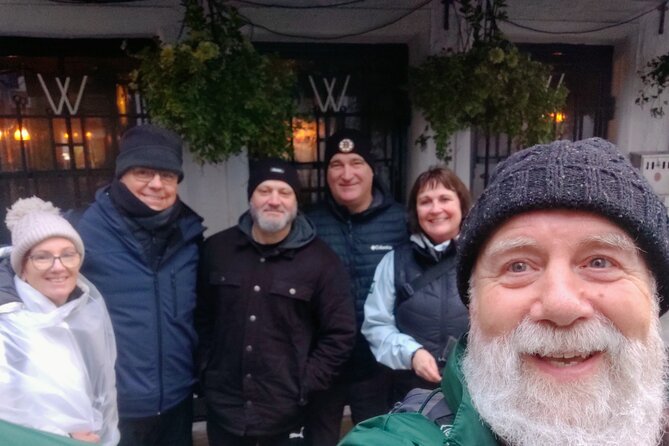
The walk begins around Belfast City Hall, where you spend about 30 minutes. This is a sensible starting point because the building and its surroundings offer a quick lesson in Belfast’s civic ambition and public image.
You’ll hear about the architecture and the city’s development while looking at one of Belfast’s most important public spaces. This opening also gives Martin time to establish the larger story before the group moves into smaller streets.
I like that this is not treated as a quick photo stop. Thirty minutes lets you look properly and ask questions. It also gives you a firm reference point for understanding how the city center was planned and how public power was displayed.
There is no admission charge for this stop. The tour focuses on the exterior and surrounding area rather than promising entry inside.
Ulster Hall and Belfast’s public stage
A short stop beside Ulster Hall follows. The building has more than 160 years of performances behind it, and Martin explains the different characters and acts connected with its stage.
This adds a cultural layer to the walk. Belfast is not presented only through politics and conflict, but also through music, public gatherings, and entertainment. A stop of around 10 minutes will not allow a full architectural study, but it should give you a useful story and a chance to place the hall within the city’s social life.
The stop is free, and you do not need to plan for a separate admission ticket.
The Belfast Entries: narrow lanes with long memories
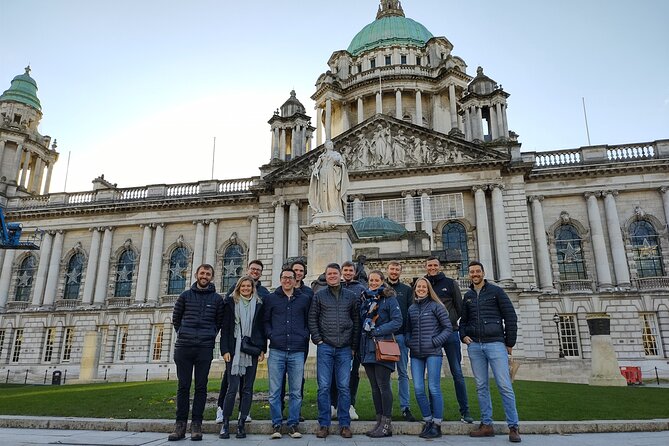
The Belfast Entries are among the most distinctive parts of the route. These old passageways preserve a sense of earlier Belfast, and the tour walks in the footsteps of important local figures connected with the city’s past.
This is where the walk shifts from grand public buildings to tighter, more atmospheric spaces. You can better imagine how people moved through old Belfast, traded, met, and built their working lives around lanes rather than broad modern streets.
The stop lasts about 20 minutes. That is enough time to explore the character of the area while keeping the tour moving. Watch your footing and stay close to the guide, since narrow streets and passing pedestrians can make it harder to hear if you drift behind.
For me, this is the kind of place where a local guide earns the fee. Without explanation, an old lane can look like a shortcut. With the right context, it becomes part of the city’s story.
A few more things worth booking around Belfast
- Giants Causeway & Castles Tour from Belfast: Guided tour
★ 5.0 · 1,432 reviews - Guided Day Tour of Giant’s Causeway from Belfast by Comfortable Coach
★ 5.0 · 740 reviews - Guided Day Tour: Giant’s Causeway from Belfast
★ 5.0 · 489 reviews - Northern Highlights Full-Day Guided Tour in Northern Ireland
★ 5.0 · 181 reviews
St Mary’s and the heart of Folktown
At St Mary’s Roman Catholic Church, you’ll learn about Belfast’s first Catholic church and its place at the center of Folktown. The stop lasts about 10 minutes.
This part of the route helps explain the religious and social divisions that shaped Belfast. It also keeps the story grounded in community life rather than presenting the past only through government buildings and political leaders.
The church is included as an exterior stop, with no separate admission charge listed. The guide’s explanation is the main reason to pause here, so listen closely and ask questions if you want to understand how this area fitted into the wider city.
Kelly’s Cellars and stories of dissent
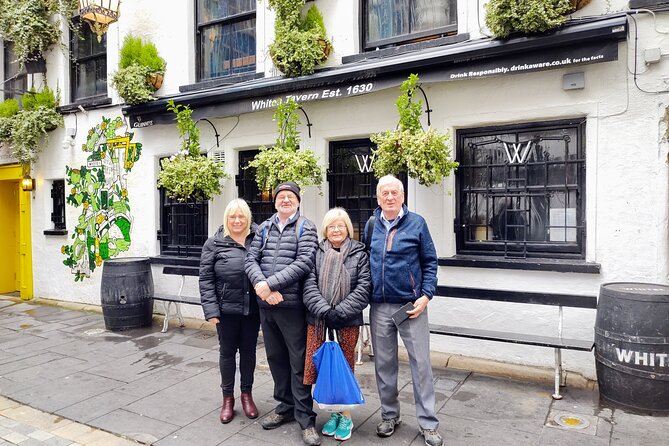
Kelly’s Cellars is described as Belfast’s oldest family-owned bar. The tour pauses here for about five minutes to explain its links with revolution and dissent.
Five minutes is short, but that is probably enough for a story and a look at the building. This is not a scheduled food or drink stop, and snacks are not included. Think of it as a historic landmark, not a pub crawl.
The stop is useful because pubs can reveal a side of political history that formal buildings cannot. They were places where people met, argued, organized, and passed on ideas. You get a glimpse of that world without the tour needing to turn into a long discussion of one site.
The Linen Quarter and Belfast’s industrial wealth
The walk then reaches the Linen Quarter, where the main linen warehouses from the mid-1800s show how industry shaped Belfast.
This is one of the most important context stops. Belfast’s wealth did not appear by accident. The linen trade helped drive the city’s growth, and warehouse architecture gives you something concrete to look at while learning about that economic past.
The stop lasts around 10 minutes. Admission is included, though the supplied details do not specify an interior visit. You should expect the guide to interpret the area rather than spend a long period inside a museum or working warehouse.
The Linen Quarter also provides a useful contrast with the Belfast Entries. One shows older lanes and local movement, while the other reflects large-scale commerce and industrial ambition.
Queen’s Arcade and the Assembly Rooms
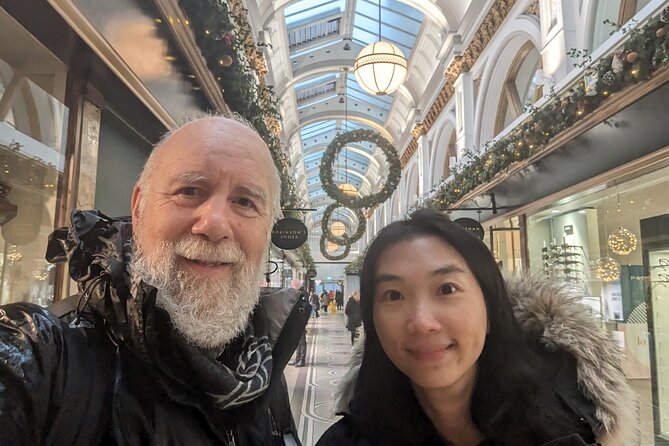
Queen’s Arcade is a Victorian shopping arcade, visited for about 10 minutes. It gives the walk a lighter change of pace, showing the commercial and social side of central Belfast.
Arcades are easy to pass without noticing, especially when you are concentrating on major landmarks. A guide can point out the details that explain why these spaces mattered to shoppers and city life.
The route then reaches the Assembly Rooms, Belfast’s oldest public building, for about 15 minutes. This stop returns the focus to public life, meetings, worship, and political activity.
The itinerary also refers to the place where Belfast leaders and revolutionaries met and worshipped. That detail matters because it connects civic, religious, and political history in one part of the city. The exact stop is not separately named in the supplied information, so you should treat it as part of the broader route rather than expect another fully timed attraction.
The Crown Liquor Saloon’s remarkable interior
The Crown Liquor Saloon is one of the most visually memorable stops. The tour spends about 10 minutes here, explaining the story behind the pub and allowing you to admire its Victorian interior.
The description calls it an iconic Victorian gin palace. You do not need to be interested in pub culture to appreciate the craftsmanship and atmosphere of the building. It is a good reminder that Belfast’s history also survives in places built for ordinary pleasure and social life.
Admission is free. The tour does not list a drink or snack as part of the price, so plan to visit independently later if you want to sit down inside.
The Europa Hotel and the Troubles in context
The final major stop is the Europa Hotel, where you spend about 15 minutes. The hotel became known as a base for the world’s press and media during the Troubles.
This is where the tour’s modern political story comes into sharper focus. The walk is not presented as a dedicated Troubles tour, but the subject cannot be left out of an honest account of Belfast. The Europa helps show how international journalists experienced the city during those years and how conflict shaped Belfast’s public image.
The broader approach is helpful. You are not asked to understand Belfast through one period alone. Instead, the Troubles are placed alongside older religious divisions, industrial change, political movements, and the city’s continuing daily life.
If you want a tour focused almost entirely on murals, interface areas, or conflict sites, this may not be the right choice. If you want the Troubles explained as one part of Belfast’s longer story, the balance should suit you.
What the nearly three-hour format means
The tour lasts approximately 2 hours 45 minutes to 3 hours. That is enough time to explain a complicated city properly, but it does require commitment.
The pace is described as leisurely, and the route stays in central Belfast. Even so, you remain on your feet for most of the experience. Comfortable shoes are essential, and you should dress for all weather. The tour runs in rain and other conditions, so a waterproof layer is a sensible choice.
The activity requires moderate physical fitness and is not recommended for people with unassisted mobility issues. Service animals are allowed, and the meeting point is near public transport.
The small group makes the long format easier. Martin can adjust his explanation, answer questions, and avoid the strained atmosphere that often comes with a large crowd. A group of fewer than 10 is possible, though the maximum is 12.
Is $27.78 good value?
At $27.78 per person, the price is reasonable for a nearly three-hour guided walk, especially in a group capped at 12. You are paying mainly for interpretation, local knowledge, and the time required to connect many parts of Belfast.
There are no major attraction admissions or food costs included beyond the stated fees and taxes. Snacks are not included, and the pub stops are not presented as tastings. That keeps the price simple, but you should budget separately for anything you buy during or after the walk.
The strongest value comes if you are new to Belfast. A good first tour can save you time later by showing where the central landmarks sit and giving you the background to understand them. It also gives you a chance to ask Martin for food and drink suggestions. He has provided practical recommendations for the rest of the city to people on the walk.
The tour is often booked about 31 days ahead. That suggests you should reserve early if your Belfast dates are fixed, particularly if you want the small-group experience.
Who should choose this tour?
I would choose this walk if you want Belfast explained by someone local, with a fair account of the city’s complicated past. It suits first-time visitors, history fans, couples, families with older children, and anyone who prefers conversation to a scripted audio guide.
It is also a good option if you want more than the Troubles. You’ll hear about the city’s early development, linen, churches, political movements, public buildings, shopping, pubs, and media history.
You may want something else if you dislike long walks, need frequent seating, or want to spend most of your time inside attractions. It is also not the best match for someone seeking a specialized political tour focused only on the conflict.
The cancellation terms are straightforward: you can receive a full refund if you cancel at least 24 hours before the 10:30 am start. Changes or cancellations inside that window are not accepted for a refund. A minimum group size applies, and if the tour is canceled for that reason, you are offered another option or a full refund.
Should you book the Real Story of Belfast walk?
Book it if you want a clear, human introduction to Belfast rather than a quick list of sights. Martin’s personal connection, even pace, balanced presentation, and willingness to answer questions are central to the experience.
The route has real variety: City Hall, old entries, a Catholic church, a historic pub, linen warehouses, a Victorian arcade, an old public building, the Crown, and the Europa Hotel. You get a useful picture of how Belfast grew and why its past still matters.
Skip it if nearly three hours on foot sounds tiring or if you want a narrow focus on one subject. For most first visits, though, $27.78 is a fair price for a small-group walk that gives you the background needed to see Belfast with sharper eyes.
FAQ
How long does the Real Story of Belfast walking tour last?
The tour lasts approximately 2 hours 45 minutes to 3 hours.
What time does the tour begin?
The tour starts at 10:30 am.
Where does the tour meet?
The meeting point is Belfast City Hall, Belfast BT1 5GS, UK.
Where does the tour finish?
The activity ends back at the City Hall meeting point.
What language is the tour offered in?
The tour is offered in English.
How large is the group?
The maximum group size is 12 people.
Is the tour suitable for people with mobility issues?
The tour requires moderate physical fitness and is not recommended for people with unassisted mobility issues. Comfortable shoes are recommended because this is a walking tour.
Just added in Belfast
- Belfast Black Cab Taxi Private Tour 2hr with Original Guides★ 5.0 · 10 reviews
- Luxury Party Bike Tour of Belfast City (Individual Seat)★ 4.5 · 21 reviews
- The Hippy Bike Fully Enclosed Party Bike Tour (Private Bike)★ 5.0 · 18 reviews
- Game of Thrones Private Tour with the Other Ser Davos 1-4 people★ 5.0 · 46 reviews
- Titanic Museum and Whiskey Distillery Exploration with Tasting★ 4.5 · 25 reviews
- Private Giants Causeway & Antrim Coast Tour★ 5.0 · 26 reviews
- Private Shore Excursion From Belfast Cruise Terminal★ 5.0 · 26 reviews
- Private Giants Causeway and Antrim Coast Tour★ 5.0 · 40 reviews
Walking Tours, compared.
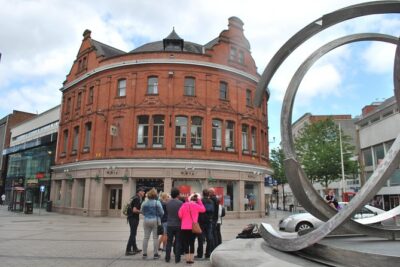
A History of Terror – Belfast City Centre Walking Tour
Read our review →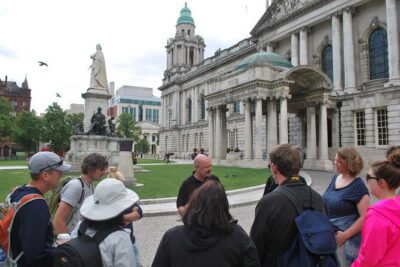
Belfast Eclectic Walking City Center Experience, The Marti Way
Read our review →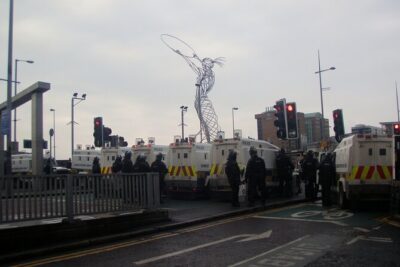
Belfast Troubles Murals Street Art and Peace Wall Walking Tour
Read our review →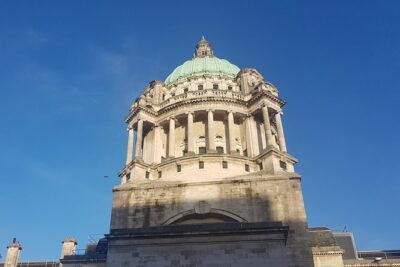
The Real Eclectic Belfast City Walking Tour/Experience.
Read our review →
Browse the lists this tour appears in